
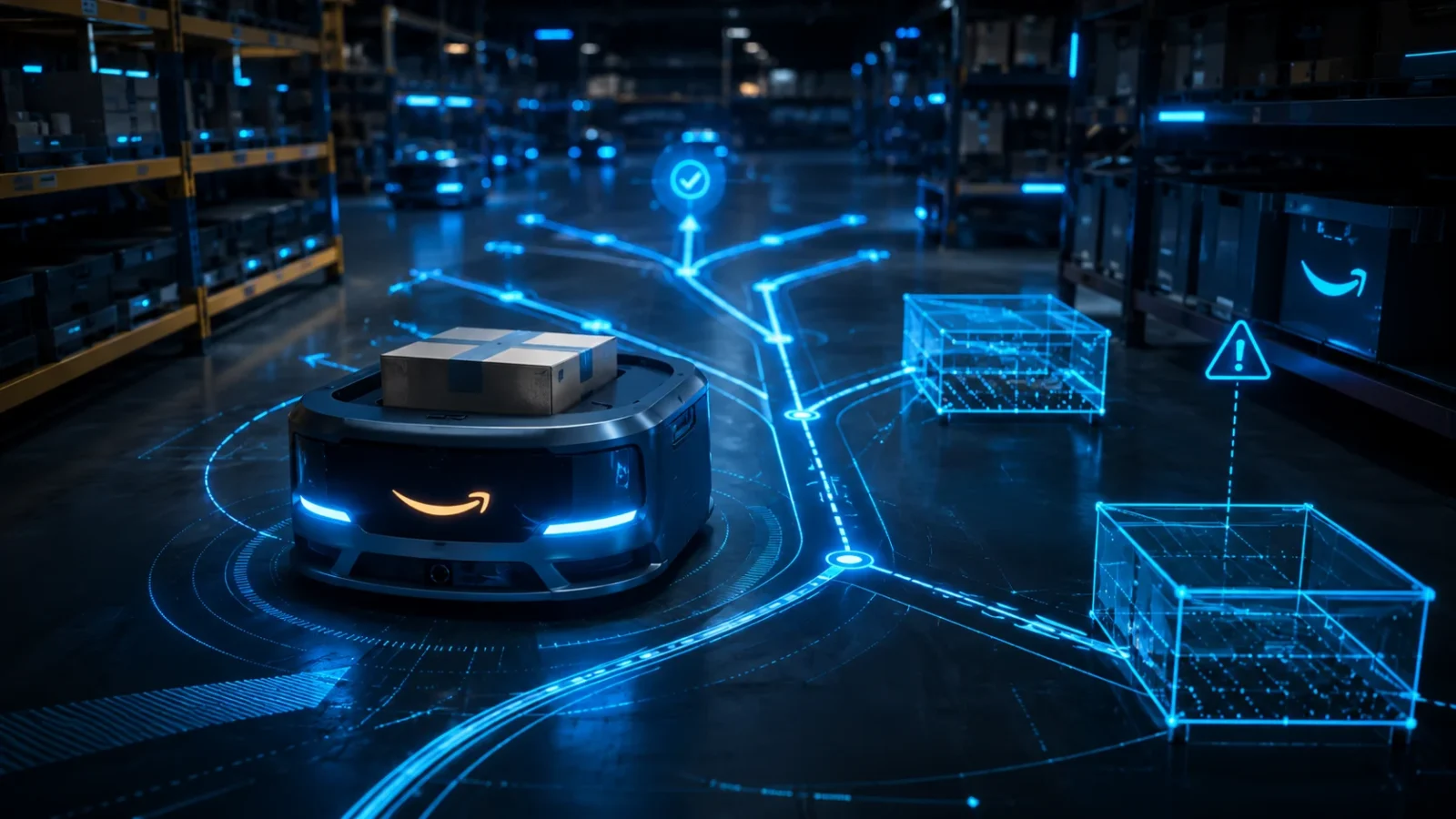
Amazon has introduced a new version of Proteus, its warehouse robot, now upgraded with more advanced artificial intelligence to operate inside fulfillment centers. The announcement was made at the company’s “Delivering the Future” event in the UK and is part of a €10 billion, roughly $11.6 billion, investment in Amazon’s European logistics network.
The idea is clear: AI is no longer just a chatbot on a screen. It is starting to gain wheels, sensors, and real-world tasks.
Quick answer: what is happening?
Amazon upgraded Proteus, its mobile warehouse robot, so it can understand conversational commands, set priorities, choose routes, and calculate the best timing to complete tasks. The new version is expected to operate across larger areas of warehouses and launch in Europe in early 2027.
What is Proteus?
Proteus is a mobile robot built to move around Amazon fulfillment centers. It helps transport and move items, reducing repetitive tasks and speeding up logistics operations.
The big difference now is that it is becoming smarter. Before, this type of robot followed more limited routes and functions. With the new version, Amazon wants Proteus to better understand its environment, interpret commands, and make operational decisions with more autonomy.
AI is leaving the chat and moving to the warehouse floor
Over the past few years, most of the AI hype has focused on text, images, videos, and digital assistants. But Amazon’s move shows another major frontier: physical AI.
Instead of simply answering questions, AI is starting to control machines, move objects, optimize routes, and work in real spaces.
That changes the game. In the digital world, an AI mistake can generate a bad answer. In the physical world, a mistake can hit a shelf, block a delivery flow, or put people at risk. That is why autonomy in robots needs much tighter control.
Does the robot understand commands?
According to Reuters, the new version of Proteus can respond to conversational commands and decide tasks, routes, and timing inside the warehouse.
In practice, an operator can give a more natural instruction, and the robot needs to understand the goal, evaluate the environment, and perform the task in the most efficient way.
It is the kind of improvement that may sound small, but could transform logistics at scale.
Amazon also showed other robots
Alongside Proteus, Amazon also introduced STARK, a robotic system for handling boxes and containers, and Vulcan, its first robot with a sense of touch.
That detail matters because it shows the strategy does not depend on one single robot. Amazon is building an automation ecosystem: machines that transport, grab, sense, organize, and collaborate inside operations.
The impact on work
Every time a big tech company introduces more autonomous robots, the same question appears: will this replace workers?
The honest answer is: some repetitive tasks will likely be automated, yes. But that does not mean humans disappear from warehouses. The most likely scenario is a shift in the type of work: less repetitive physical effort and more supervision, maintenance, operation, and system control.
But this transition is not automatic or simple. Companies and governments will need to deal with training, safety, and the impact on jobs.
Why this matters to you
Even if you never work in a warehouse, this technology affects daily life. Smarter robots can make deliveries faster, reduce errors, lower costs, and improve efficiency for major retailers.
At the same time, they raise important questions about privacy, safety, jobs, and dependence on automation.
AI is no longer trapped inside the browser. It is entering factories, logistics centers, and soon many physical spaces.
Frequently asked questions
What is Proteus?
Proteus is Amazon’s mobile robot used in fulfillment centers to help move items and optimize logistics tasks.
What changed in the new version?
The new version gained AI features to understand conversational commands, choose routes, prioritize tasks, and operate with more autonomy.
When will this robot arrive in warehouses?
According to Reuters, the new version of Proteus is expected to launch in Europe in early 2027.
Could this affect jobs?
Yes, especially repetitive warehouse tasks. But it may also create demand for roles related to robot operation, maintenance, and supervision.
To the DigitalRadar, this is can one of the biggest shifts in AI: it is leaving the screen and starting to move the physical world.

Related

EU Kids Act: Europe Proposes Banning Social Media and Chatbots for Under-15s
The most sweeping plan yet to protect children online lands in Brussels this Thursday: age-based access tiers, supervised accounts from 13 to…

The GTA 6 Hackers: From the Lapsus$ Teen to the CyberLeek Who Leaked the Map
GTA 6 is the most leaked game in history. In 2022 a Lapsus$ teenager posted 90 videos using a Fire Stick in…
Broadcom Books $29.6B and Nvidia Promises 7x More AI per Megawatt
Broadcom booked $29.6 billion in quarterly revenue (+86%) selling custom AI chips, while Nvidia unveiled Vera Rubin with up to 7x more…