
Project Suncatcher: Google Launched TPUs Into Space to Test Data Centers
 by Lucas Almeida
4 min read
by Lucas Almeida
4 min read
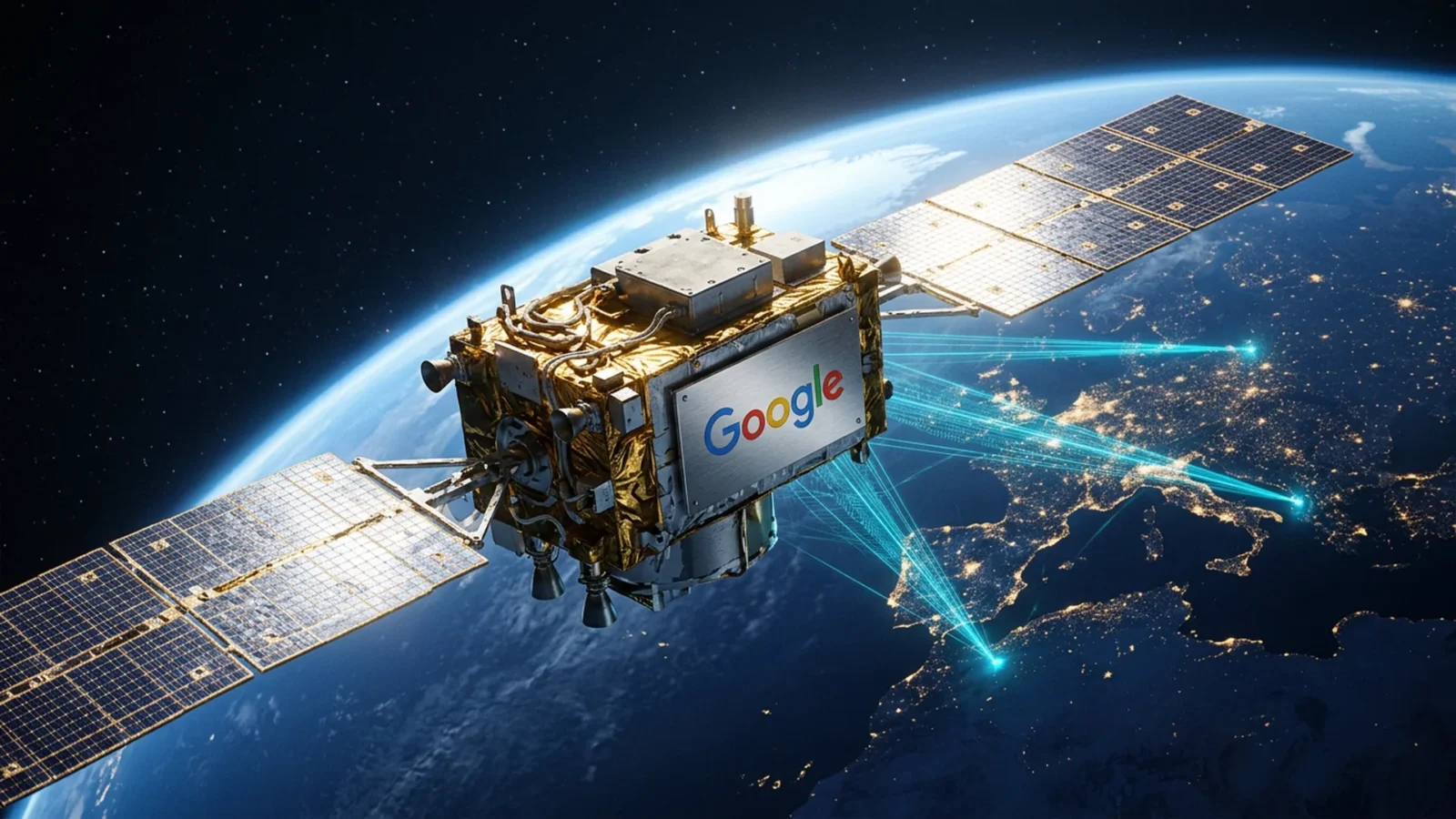
Google launched four of its artificial intelligence chips — TPUs (Tensor Processing Units) — into space aboard a SpaceX rocket. The goal of Project Suncatcher, announced on October 1, 2026, is to answer a direct question: do the building blocks of a data center survive and work in orbit? If the answer is yes, Google wants to solve in space the problem that constrains AI on Earth — power. In a sun-synchronous orbit, a solar panel generates up to eight times more than it would on the ground, and almost never sits in shade.
Quick answer: what is Project Suncatcher?
A Google moonshot to put AI data centers in space. The prototype is a satellite carrying four TPUs in a sun-synchronous orbit, where the panels are virtually never in shadow — removing the need for heavy batteries and backup power. The energy generated is transmitted wirelessly. The next step is a partnership with Planet Labs to launch two satellites by early 2027, aiming long term at clusters of 81 satellites in formations roughly 1 km across.
Why space solves the power problem
| Factor | On Earth | In orbit (Suncatcher) |
|---|---|---|
| Solar generation | Limited by night, clouds and seasons | Up to 8x more power per panel; near-shadowless orbit |
| Batteries | Needed for night and peaks | Unnecessary in a sun-synchronous orbit |
| Cooling | Industrial-scale water and HVAC | Dissipation in vacuum (its own engineering challenge) |
| Expansion limit | Power grid and local permitting | Launch cadence and cost per kilogram to orbit |
The math fits a year in which the industry metric became “tokens per megawatt”: Nvidia promises 7x more throughput per megawatt with Vera Rubin, startups like Crusoe raise billions just to build where power is spare, and the U.S. Congress passed a bill shielding consumers from data-center electricity costs.
The obstacle Google itself admits
Scale. The largest AI data centers under construction today pack hundreds of thousands of chips and draw up to 1 gigawatt — several thousand times more than the International Space Station’s solar arrays produce. Going from four TPUs to anything comparable requires simultaneous advances in launch cost, wireless power transmission, cooling in vacuum and maintaining hardware nobody can visit. Google treats the project as long-term research, not a product.
Not the only one looking up
Orbital computing came back into fashion in 2026 for a simple reason: electricity became AI’s physical limit. Satellite companies, space-energy startups and even chipmakers are studying it. Google’s edge is owning the chip (the TPU), the cloud and a satellite partner — meaning it can test the full stack without depending on third parties.
Why this matters to you
In the short term, nothing changes in what you pay for ChatGPT or Gemini. In the medium term, Suncatcher is a gauge of how serious the energy constraint is: when the world’s most infrastructure-rich company starts launching chips into space, building on Earth has gotten hard. For regions with cheap renewable power, the message is the opposite and optimistic: while Google hunts sunlight in orbit, they already hold the asset that attracts data centers — provided transmission keeps up.
Frequently asked questions
What is Project Suncatcher?
An experimental Google project to place AI data centers in orbit. The prototype launched in October 2026 carries four TPUs and tests whether the hardware works in space.
Why put data centers in space?
Because in a sun-synchronous orbit solar panels generate up to eight times more power and are almost never in shadow, removing the need for batteries — and power is today the main limit on expanding AI data centers.
When does this become real?
There is no date. The next step is two satellites with Planet Labs by early 2027. Google itself admits scale is the biggest obstacle.
At DigitalRadar, we follow the giants’ long-term bets. Stay on the radar so you do not miss the next one.
Related
Apple commits $5B to solar-powered data centers for Apple Intelligence
Marking one of its largest domestic infrastructure expansion initiatives under updated executive leadership, Apple officially announced on Tuesday, September 22, 2026, a…
Meta and Qualcomm Sign Multi-Year 2nm Chip Alliance Ahead of Connect 2026
Ahead of Meta Connect 2026, Mark Zuckerberg and Cristiano Amon announced a major expansion of their strategic hardware partnership: Qualcomm will build…
Nvidia Promises to Sell Twice as Many Chips in 2027 After a $96 Billion Quarter
At an event in the UK, Jensen Huang predicted Nvidia will sell twice as many chips next year. The forecast sits on…