
Intel Nova Lake-S: Desktop CPUs with 3D Cache and 70 TOPS NPU for Local AI
 by Lucas Almeida
3 min read
by Lucas Almeida
3 min read
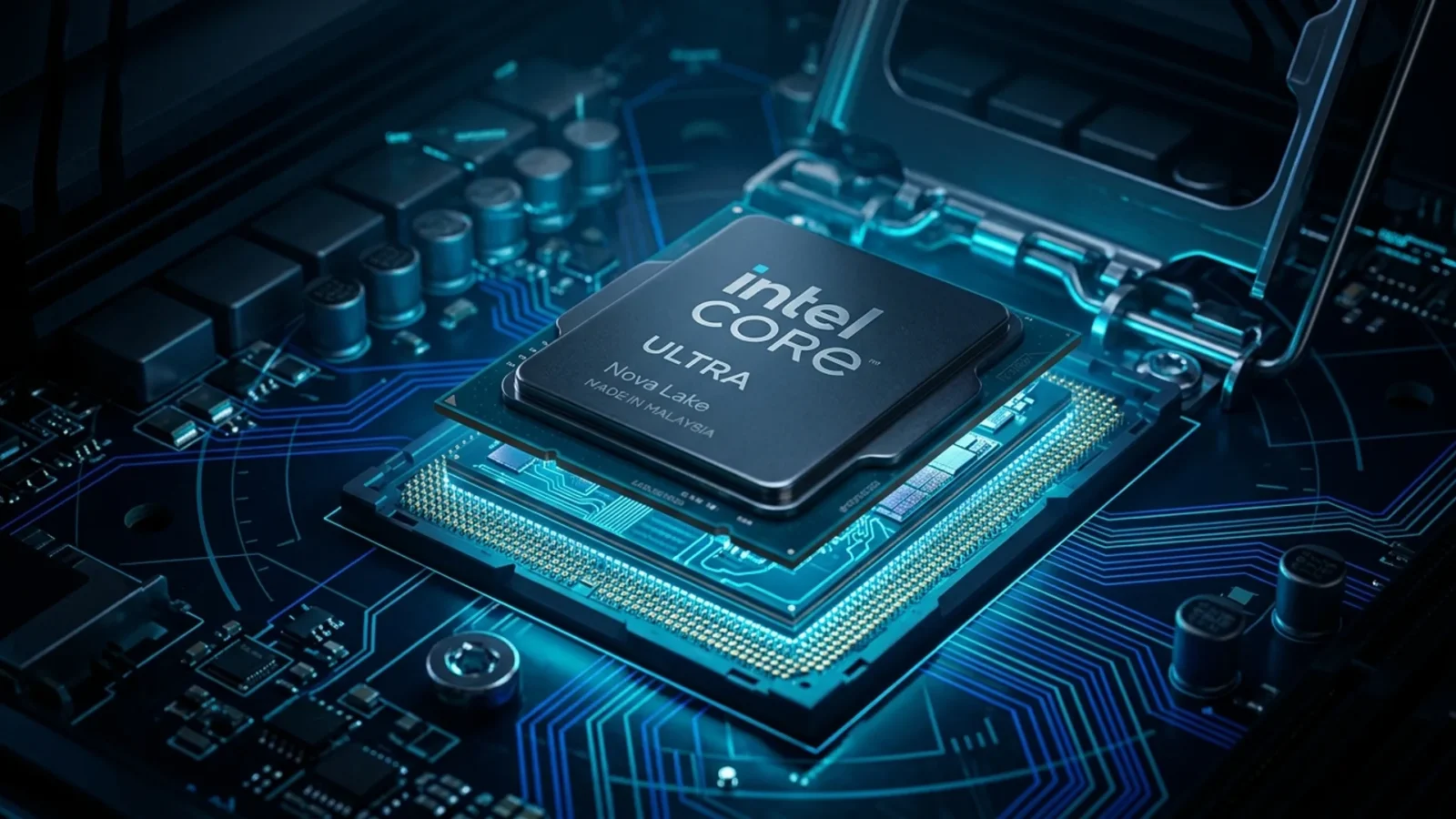
On September 21, 2026, Intel formally answered AMD’s dominance in high-framerate gaming by unveiling its landmark Nova Lake-S desktop processor architecture (marketed under the Core Ultra 300 series banner). Fabricated on a hybrid multi-tile process leveraging Intel 14A and TSMC N2 lithography, the flagship desktop processors pack up to 28 heterogeneous cores, an innovative vertically stacked 3D b-Cache reaching up to 144 MB of aggregate cache, and a dedicated 70 TOPS Neural Processing Unit (NPU) tailored for on-device AI inference.
Quick answer: what makes Nova Lake-S groundbreaking?
For the first time in desktop history, Intel has successfully deployed modular 3D vertical SRAM stacking (b-Cache) directly over compute dies, systematically targeting the low 1% framerate advantages previously held by AMD’s X3D series. Furthermore, the 70 TOPS Gen 5 NPU enables power users to run quantized local large language models (such as LLaMA 3.2 and Mistral Large) without stealing rendering compute from high-end discrete GPUs.
Architectural innovations: Coyote Cove and 3D b-Cache
Nova Lake-S represents Intel’s most substantial ground-up desktop silicon redesign in nearly a decade, anchored by advanced Foveros Direct 3D die interconnects:
- Coyote Cove P-Cores: new performance cores deliver an estimated 18% instructions-per-clock (IPC) enhancement, while Arctic Wolf efficiency cores double inter-cluster L2 cache bandwidth;
- 3D b-Cache technology: a dedicated 96 MB high-density SRAM slice is bonded directly beneath the compute tile, providing rapid zero-wait access to frequently queried game physics and spatial assets;
- Gen 5 integrated NPU: operating at up to 70 TOPS of INT8 precision, the integrated engine processes local speech recognition, live video matting, and background agentic telemetry at under 15 watts of system draw.
Head-to-head spec comparison: Core Ultra 9 385K vs Ryzen 9 9950X3D
| Technical Parameter | Intel Core Ultra 9 385K (Nova Lake) | AMD Ryzen 9 9950X3D |
|---|---|---|
| Core Configuration | 28 Cores (8P + 16E + 4LP) | 16 Cores (32 Threads) |
| Max Boost Clock | Up to 5.9 GHz | Up to 5.7 GHz |
| Total Cache Pool | 144 MB (L3 + 3D b-Cache) | 144 MB (L3 + 3D V-Cache) |
| Onboard NPU Throughput | 70 TOPS (Gen 5 NPU) | 16 TOPS (XDNA 2) |
| Memory Support | DDR5-7200 native (CUDIMM) | DDR5-6000 native |
| Base / Peak Power | 125 W / 240 W | 120 W / 170 W |
| Motherboard Socket | LGA 1851 (Z890 / Z990) | AM5 |
Why this matters to you
For PC builders, competitive gamers, and professional software developers, intense architectural rivalry between Intel and AMD drives rapid price-to-performance competition. By pairing high-bandwidth 3D cache with a 70 TOPS neural co-processor, desktop workstations can now execute private generative assistants, automated unit testing, and real-time noise cancellation locally without sending proprietary project data to external cloud APIs or exhausting graphics card VRAM reserves.
Frequently asked questions
Will Nova Lake-S require a brand-new motherboard socket?
No. Intel continues its platform commitment on the LGA 1851 socket. Existing Z890 and B860 motherboards will support Nova Lake-S via firmware updates, while upcoming Z990 boards offer expanded PCIe 5.0 lanes.
When will retail desktop processors go on sale?
Global retail availability is slated for late October 2026, alongside third-party motherboard launch lineups and high-speed CUDIMM DDR5 memory kits.
How much does the 3D b-Cache improve gaming performance?
Early internal telemetry from Intel suggests average framerate improvements of up to 22% in cache-intensive open-world simulations and physics-heavy eSports titles.
At DigitalRadar, we examine the silicon engineering powering modern computing. Stay on the radar.
Related
Plugin4Shell: The Zero-Click Flaw in Claude Code, Codex, Copilot and Gemini CLI
Air Security disclosed Plugin4Shell: a plugin that looks hash-locked can run code on your PC with no click. Claude Code (2.1.179) and…
Record Patch Tuesday Fixes ~1,000 Windows Flaws, Needs Emergency Update
Microsoft shipped the largest security update in its history on September 8 and, a week later, needed an emergency out-of-band update to…

Project Zenith: Microsoft Defines the Local-AI PC With 64GB of Memory
Microsoft unveiled Project Zenith: a Windows configuration for building and running AI on the PC itself, with a 64GB unified-memory minimum. The…