
US and EU Sign Historic Agreement Mandating C2PA Watermarks for AI Media
 by Théo Carvalho
3 min read
by Théo Carvalho
3 min read
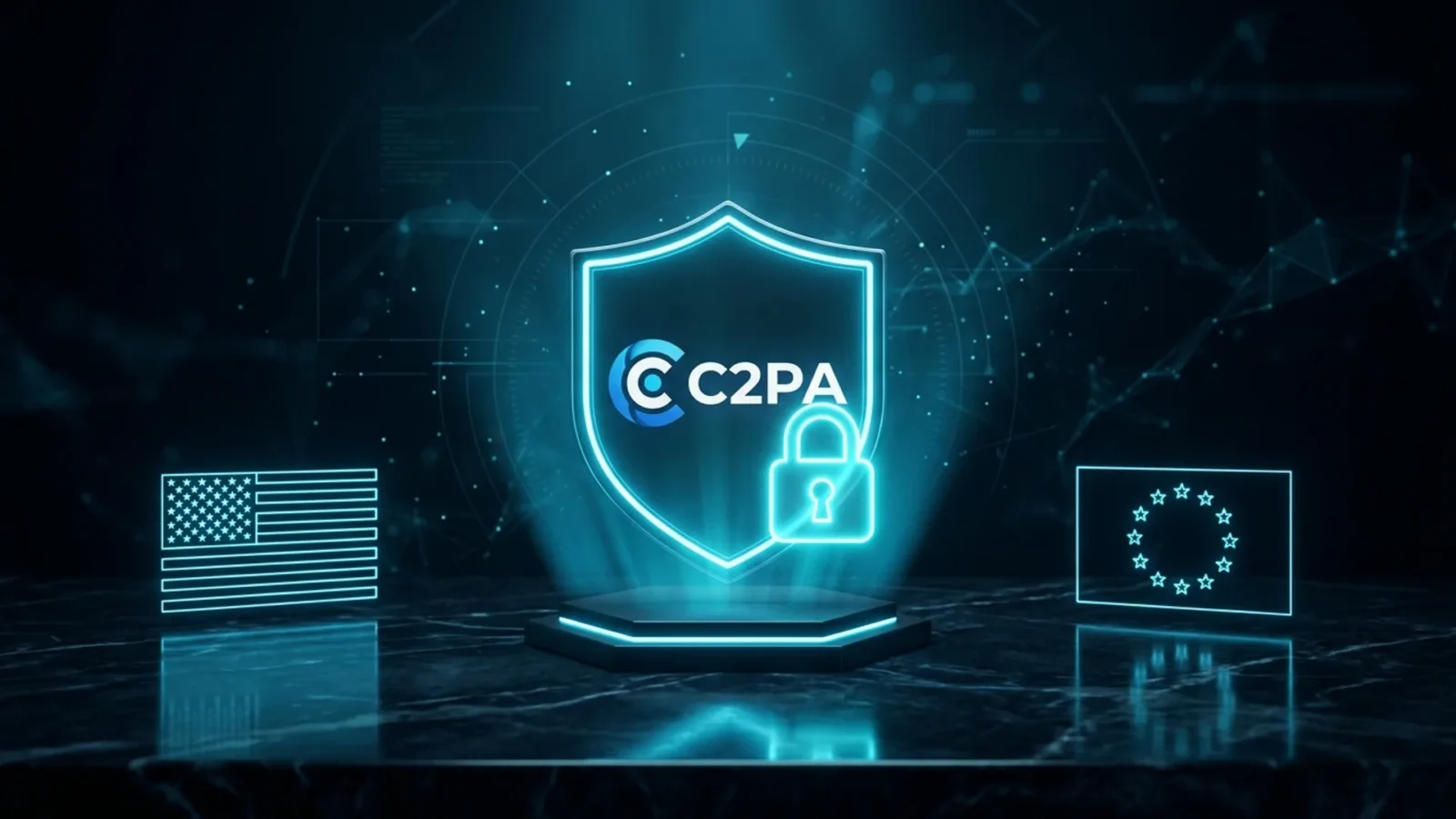
On September 21, 2026, senior trade and technology delegates from the White House and the European Commission signed the first legally binding regulatory framework between the two economic powerhouses governing synthetic digital media: the Transatlantic Synthetic Provenance Pact. The historic accord establishes the open cryptographic architecture known as C2PA (Coalition for Content Provenance and Authenticity) as a non-negotiable legal requirement for commercial generative imagery, synthetic audio, and video models distributed across Western jurisdictions.
Quick answer: what does the transatlantic agreement require?
Starting January 2027, every consumer and enterprise software vendor generating synthetic media (including OpenAI, Midjourney, Google DeepMind, and Runway) must inject immutable cryptographic metadata into every exported file. Crucially, social media platforms and distribution networks (such as Instagram, YouTube, TikTok, and X) will be prohibited from stripping or compressing these digital certificates under penalty of fines scaling up to 6% of global corporate revenue.
Understanding C2PA and cryptographic content provenance
Originally architected by a cross-industry consortium that includes Adobe, Microsoft, Intel, Sony, Nikon, and the BBC, the C2PA specification functions as an unforgeable digital birth certificate. Unlike superficial optical watermarks or fragile pixel watermarking algorithms that disappear after modest cropping or compression, C2PA anchors cryptographic manifests using chained SHA-256 cryptographic hashes:
- Tamper-evident edit tracking: whenever an asset undergoes cropping, color grading, or synthesis, the manifest records each intermediate step without destroying the authoring history;
- Hardware-level capture signing: major camera manufacturers such as Sony, Nikon, and Leica already sign authentic RAW photographs at the sensor level, establishing mathematical contrast against AI generations;
- Open verification: any web browser, operating system inspector, or open-source utility can validate the issuing authority’s public certificate without licensing fees.
Implementation milestones and regulatory timeline
| Milestone Phase | Effective Date | Mandatory Industry Requirement | Non-Compliance Consequence |
|---|---|---|---|
| Phase 1 | November 2026 | Voluntary conformance audits and public API verification | Regulatory corrective notice |
| Phase 2 | January 2027 | Mandatory C2PA v2.1 issuance on all commercial AI models | Suspension of commercial cloud distribution |
| Phase 3 | July 2027 | Mandatory social network ingestion and visual badging | Fines up to 6% annual global turnover (EU) |
Why this matters to you
The proliferation of photo-realistic synthetic media has eroded trust across political discourse, consumer fraud protection, and judicial evidence standards. With the United States and European Union unifying their technical standards, consumers will no longer need to squint at misshapen hands or artificial lighting artifacts to evaluate authenticity. Mainstream web browsers (Chrome, Safari, Edge, Firefox) will automatically display a persistent informational badge in media headers: clicking it provides verifiable proof of whether the picture was captured by an optical camera lens or synthesized in a remote server farm.
Frequently asked questions
Does C2PA metadata degrade image or video quality?
No. C2PA certificates reside within the header metadata container of the digital file and do not alter visual pixels, color accuracy, or rendering resolution in any manner.
What happens if a user strips the metadata with editing software?
When an asset with removed provenance metadata is uploaded to compliant platforms or web browsers, it is automatically classified as “unverified provenance”, warning users that the chain of custody has been severed.
Are open-source models exempt from the requirement?
Independent hobbyists running local offline models are not policed directly, but commercial hosting services, model repositories (like Hugging Face), and cloud inference providers will be legally required to sign outputs upon generation.
At DigitalRadar, we monitor the global regulations shaping tomorrow’s technology landscape. Stay on the radar.
Related
Braking AI: Anthropic Signs a $1B Accenture Deal and Gets Sued Over a Cartel
A week after the "We Must Pace the Frontier" essay, Dario Amodei turned rhetoric into a contract: embedded Accenture evaluators inside Anthropic,…

EU Kids Act: Europe Proposes Banning Social Media and Chatbots for Under-15s
The most sweeping plan yet to protect children online lands in Brussels this Thursday: age-based access tiers, supervised accounts from 13 to…

The GTA 6 Hackers: From the Lapsus$ Teen to the CyberLeek Who Leaked the Map
GTA 6 is the most leaked game in history. In 2022 a Lapsus$ teenager posted 90 videos using a Fire Stick in…