
Apple commits $5B to solar-powered data centers for Apple Intelligence
 by Théo Carvalho
3 min read
by Théo Carvalho
3 min read
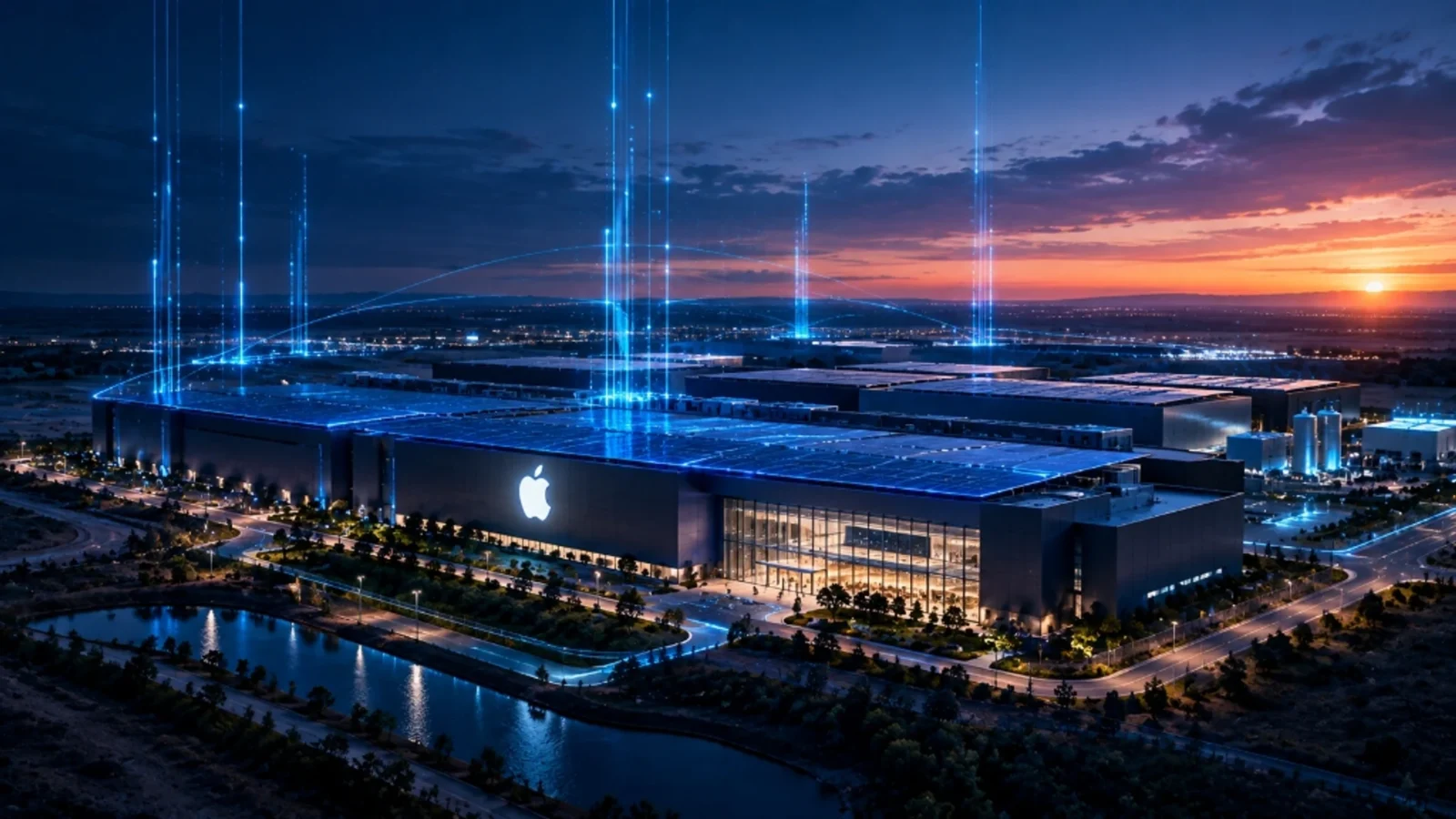
Marking one of its largest domestic infrastructure expansion initiatives under updated executive leadership, Apple officially announced on Tuesday, September 22, 2026, a $5 billion capital expenditure project to erect two hyper-scale clean energy data center campuses in Texas. The high-security facilities are designed to power surging global compute demands across the Apple Intelligence and Private Cloud Compute ecosystems.
Server-grade Apple Silicon delivering cloud autonomy
Departing fundamentally from hyperscaler competitors that rely on third-party commercial accelerator clusters, Apple is outfitting the Texas campuses exclusively with custom-racked Apple Silicon nodes (dense server blades utilizing clustered M4 Max and M4 Ultra processors).
This hardware alignment ensures that cloud-level Siri inferences and multimodal machine learning routines in iOS 27 and macOS Sequoia adhere strictly to Private Cloud Compute guarantees. Under this verifiable architectural model, user prompts reside solely within volatile RAM, are scrubbed immediately upon inference completion, and remain verifiable through public cryptographic transparency logs available to independent security researchers.
By leveraging uniform unified memory architecture shared across neural cores, Apple achieves near-zero latency inter-chip communications. Queries requiring deep context retrieval flow through custom secure enclaves without risking data exposure across multi-tenant cloud virtualizations.
Zero-carbon operation powered by dedicated solar microgrids
To preserve Apple’s 2030 corporate commitment toward carbon neutrality across its supply chains and hardware lifecycle, the Texas complex integrates an on-site 850-megawatt solar generation array coupled with industrial-scale lithium iron phosphate (LFP) battery storage modules.
Cooling systems deploy closed-loop dielectric liquid immersion mechanics that recycle treated industrial water, reducing freshwater draw by 90% compared to conventional air-chilled server farms operating in arid climates.
Strategic shielding in the generative infrastructure landscape
With an estimated 1.4 billion active Apple devices eligible for foundation AI features by the end of 2026, building proprietary server infrastructure safeguards Apple against pricing volatility and capacity shortages from commercial public cloud providers such as AWS and Microsoft Azure. Financial analysts responded positively to the announcement, emphasizing long-term protection for Services gross margins.
Initial operational clusters are scheduled to come online during the latter half of 2027, creating approximately 1,800 specialized technical positions in systems architecture and renewable energy maintenance.
Wall Street equity researchers underscored that owning custom server farms provides Apple with unrivaled vertical integration, matching its silicon efficiency on consumer devices with predictable operating expenditure in hyperscale machine learning compute.
Frequently asked questions
Does Private Cloud Compute route personal data through third-party servers?
No. When on-device Neural Engine headroom is exceeded, requests travel exclusively to Apple-owned Private Cloud Compute silicon nodes over end-to-end encrypted tunnels.
What silicon microarchitecture powers Apple’s cloud clusters?
The server blades run high-efficiency M3 and M4 family Apple Silicon chips tuned for maximal matrix multiplication performance per watt.
Will this expansion threaten Apple’s 2030 environmental pledge?
Apple confirmed that 100% of the facility’s operating power is contracted from newly added renewable sources, maintaining the trajectory toward net-zero corporate emissions by 2030.
Related

Meta and Qualcomm Sign Multi-Year 2nm Chip Alliance Ahead of Connect 2026
Ahead of Meta Connect 2026, Mark Zuckerberg and Cristiano Amon announced a major expansion of their strategic hardware partnership: Qualcomm will build…
Nvidia Promises to Sell Twice as Many Chips in 2027 After a $96 Billion Quarter
At an event in the UK, Jensen Huang predicted Nvidia will sell twice as many chips next year. The forecast sits on…

Broadcom Books $29.6B and Nvidia Promises 7x More AI per Megawatt
Broadcom booked $29.6 billion in quarterly revenue (+86%) selling custom AI chips, while Nvidia unveiled Vera Rubin with up to 7x more…