
Nvidia unveils GeForce RTX 5090 Blackwell with 32GB GDDR7 and DLSS 4
 by Théo Carvalho
3 min read
by Théo Carvalho
3 min read
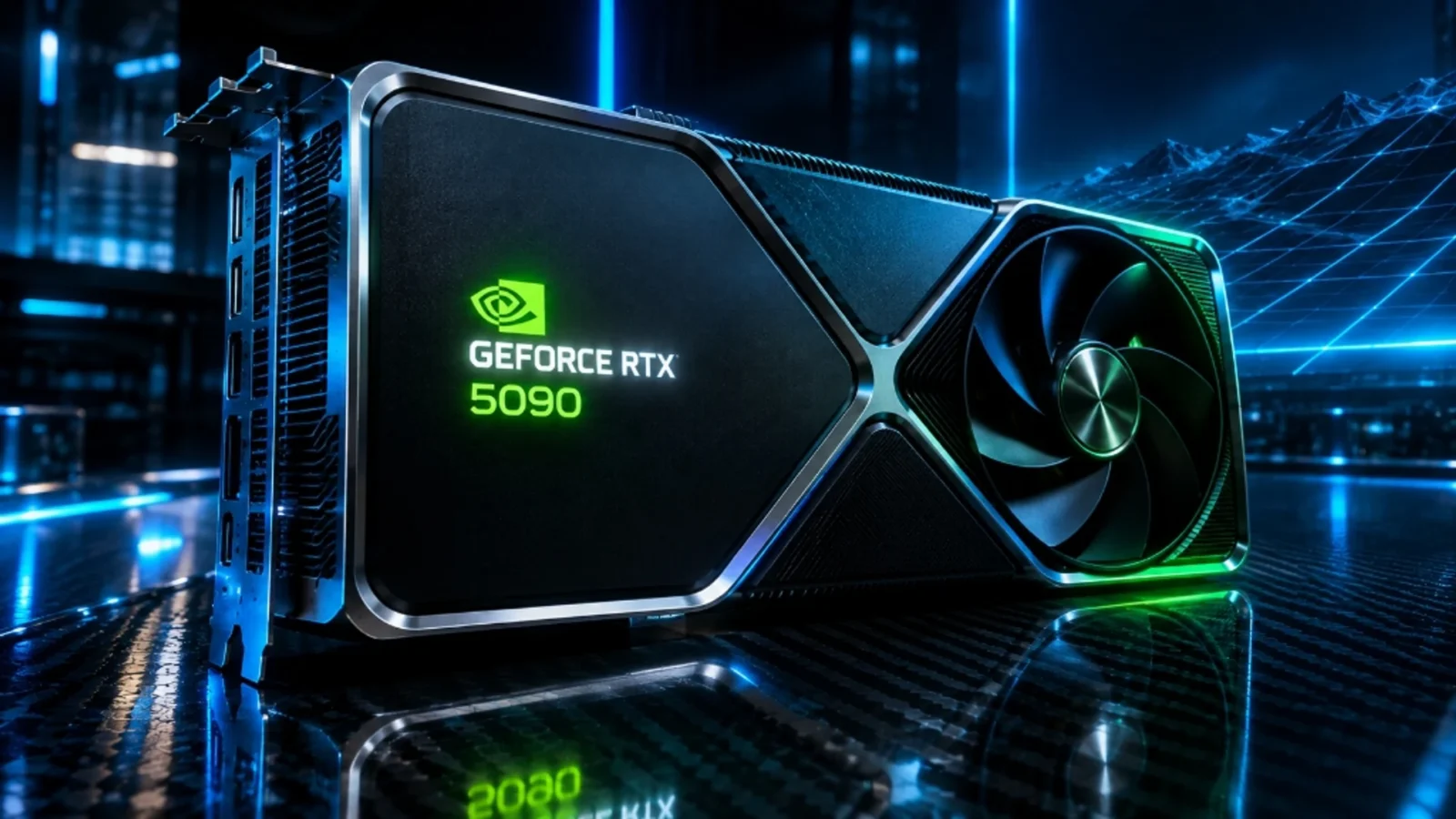
Nvidia brought months of enthusiast hardware anticipation to a crescendo on the morning of September 22, 2026, by formally publishing the comprehensive technical blueprint for its consumer flagship graphics card: the GeForce RTX 5090. Anchored by the GB202 silicon die under the Blackwell microarchitecture manufactured on a tailored TSMC 4NP node, the graphics card incorporates a colossal 32GB pool of GDDR7 memory operating at 28 Gbps across a wide 512-bit memory interface.
Unprecedented memory throughput shattering rendering bottlenecks
Deploying ultra-fast GDDR7 memory unlocks staggering peak memory throughput of nearly 1.8 TB/s—an overwhelming 75% gain over the 1,008 GB/s delivered by the predecessor RTX 4090. This colossal pipeline eliminates memory bandwidth constraints in native 8K display environments and enables local execution of 70-billion-parameter open-weights LLMs without destructive quantization.
The silicon package houses 24,576 CUDA cores, 192 fifth-generation Ray Tracing cores equipped with real-time inverse micro-mesh acceleration, and 768 fifth-generation Tensor cores featuring native FP4 numerical precision, rendering generative AI video synthesis four times faster than previous desktop components.
Content creators and 3D visualizers will find unprecedented headroom for complex scenes containing tens of millions of polygons. Real-time viewport previews in Unreal Engine 5.6 and Blender render lighting iterations without stuttering, transforming creative workflows previously reserved for rack-mounted workstation cards.
DLSS 4 introduces multi-frame neural frame synthesis
Accompanying the flagship silicon is DLSS 4 (Deep Learning Super Sampling). The software suite expands upon Ada Lovelace’s frame generation by introducing Multi-Frame Neural Synthesis, generating up to three discrete intermediate frames synthesized by neural networks for every traditionally rasterized graphics pass.
In demanding full-path-traced workloads such as Cyberpunk 2077 and Alan Wake 2, performance climbs from an unplayable 35 FPS at native 4K to a fluid 140 FPS with fidelity virtually indistinguishable from high-sample baseline renderings, while latency is kept under 20ms using updated Nvidia Reflex 2.0 synchronization.
Thermal engineering, board power, and commercial availability
Rebutting supply-chain rumors that predicted excessive power draw past 600W, Nvidia engineered the RTX 5090 Founders Edition to operate within a calibrated 500W Total Graphics Power envelope. Thermal dissipation relies on a reimagined dual-chamber vapor cooling loop with micro-machined copper fin arrays and a reinforced 12V-2×6 power interface fitted with gold-plated contact pins.
The worldwide retail launch is slated for October 15, 2026, commanding a manufacturer suggested retail price of $1,999 for the Founders Edition and customized partner cards from ASUS, MSI, and Gigabyte.
Frequently asked questions
Does the RTX 5090 mandate an ATX 3.1 compliant power supply?
Nvidia strongly recommends high-efficiency ATX 3.1 power supplies delivering between 850W and 1,000W of capacity via dedicated 12V-2×6 power conduits.
Will DLSS 4 multi-frame generation function on RTX 40 series hardware?
Multi-frame generation requires the dedicated FP4 hardware pipeline found only on Blackwell GPUs. However, enhanced Super Resolution image upscalers will trickle down to previous generations.
Is a PCIe 5.0 motherboard required to maximize gaming performance?
While the GPU operates natively across PCIe 5.0 x16 connections, it maintains backwards compatibility with PCIe 4.0 platforms, showing negligible performance differences under 2% in gaming scenarios.
Related
Intel Nova Lake-S: Desktop CPUs with 3D Cache and 70 TOPS NPU for Local AI
Intel took the wraps off its flagship Core Ultra 300 series desktop architecture (codenamed Nova Lake-S) on September 21. Featuring 3D stacked…
Plugin4Shell: The Zero-Click Flaw in Claude Code, Codex, Copilot and Gemini CLI
Air Security disclosed Plugin4Shell: a plugin that looks hash-locked can run code on your PC with no click. Claude Code (2.1.179) and…
Record Patch Tuesday Fixes ~1,000 Windows Flaws, Needs Emergency Update
Microsoft shipped the largest security update in its history on September 8 and, a week later, needed an emergency out-of-band update to…