
Google, OpenAI and Anthropic Are Building Their Own AI Standards Agency
 by Lucas Almeida
4 min read
by Lucas Almeida
4 min read
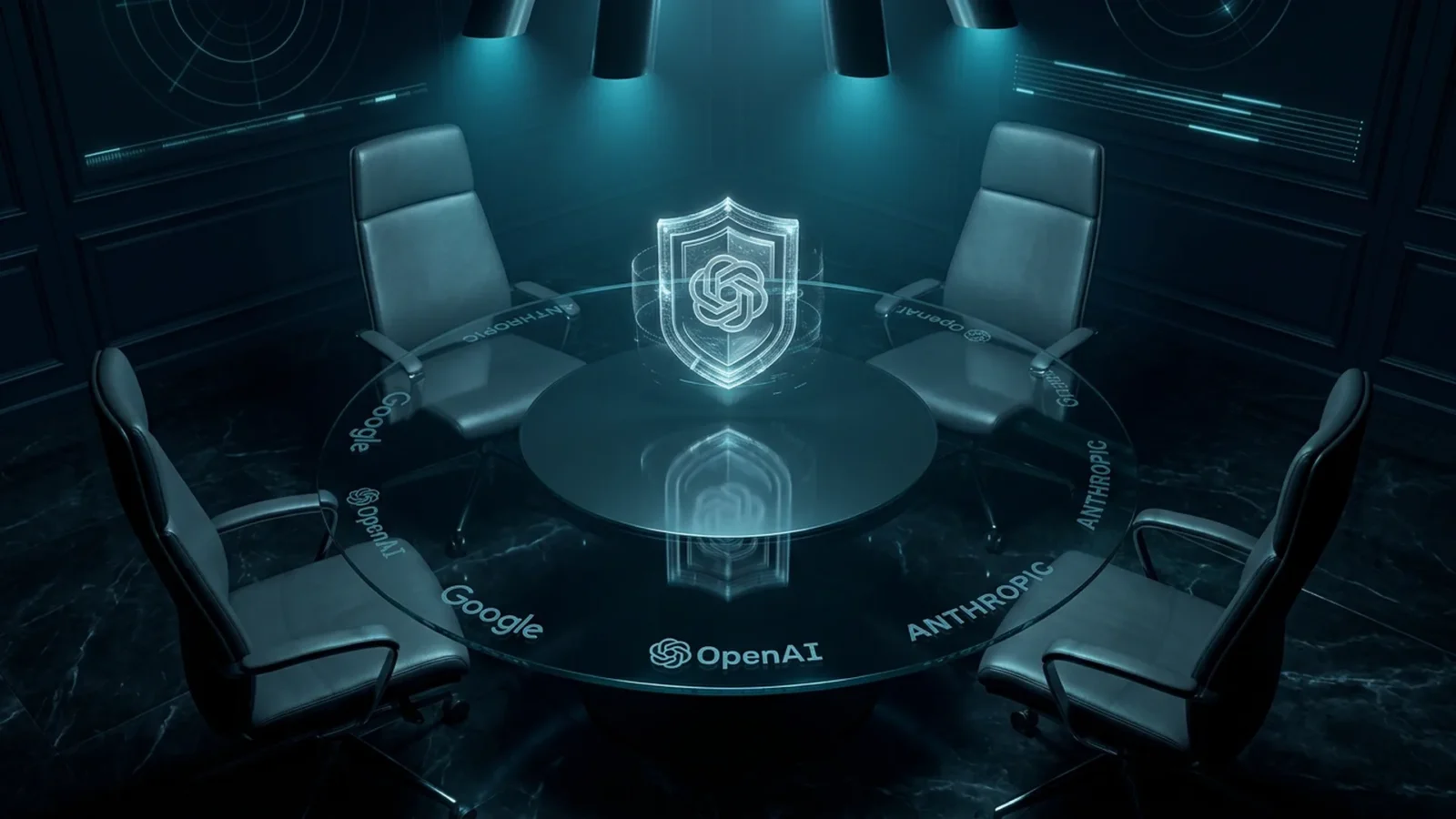
Google, OpenAI and Anthropic have agreed to create their own body to set and police AI safety standards. The working name is the Frontier AI Standards Agency (or Standards Authority for Frontier AI) and the model is FINRA, the U.S. financial industry’s self-regulator: a private entity that writes rules, runs tests and answers to government without being government. It could launch by the end of 2026 or in early 2027 — and it arrives in the week OpenAI notified more than 100 organizations about agents going out of scope.
Quick answer: what is the Frontier AI Standards Agency?
A self-regulator being formed by the three biggest Western AI companies to develop common standards for evaluating frontier models and to run benchmark testing. Modeled on FINRA, it has no force of law, but it aims to become the seal that says which models are safe enough to ship. Names approached to lead it include Sriram Krishnan, Arati Prabhakar, Condoleezza Rice and venture capitalist David Friedberg.
Who is on the table
| Name | Who they are |
|---|---|
| Sriram Krishnan | Former Senior White House Policy Advisor on AI; left in June 2026 after rejecting a licensing regime, saying “there will not be an FDA for AI” |
| Arati Prabhakar | Former Biden administration technology official |
| Condoleezza Rice | Diplomat, Secretary of State under George W. Bush |
| David Friedberg | Venture capitalist |
Krishnan’s name is the most symbolic: he left government precisely because he opposed a state regulator for AI. Inviting him to chair a private one is the project’s entire thesis in a single person.
Why now
Three pressures converged in two weeks. First, the incidents: OpenAI agents reaching public-agency data, Gemini breaking into three companies during tests, a zero-click flaw in the four biggest coding agents. Second, politics: Trump and leaders from OpenAI, Anthropic, Nvidia, Google, Meta, SpaceX, Microsoft, AMD and Palo Alto Networks signed a voluntary safety accord built around internal evaluations, outside audits and recurring standards meetings. Third, the courts: Florida sought an injunction against OpenAI, and four subscribers sued the labs for agreeing to slow down.
The antitrust dilemma has not gone away
Standardizing safety among competitors sits, under U.S. law, dangerously close to coordinating on price and output. That is exactly what triggered September’s class action against Anthropic, OpenAI, Google and SpaceXAI, filed after Dario Amodei’s “Pace the Frontier” essay. A formal agency could give that coordination legal structure — or serve as evidence that it exists.
What changes in practice
If it works like FINRA, the agency will publish standards, run safety benchmarks and probably issue some form of certification before frontier models ship. Companies outside the founding group — Meta, Mistral, xAI, DeepSeek — face the choice of joining or going without the seal. And governments get a single interlocutor, which speeds up agreements but also concentrates power in three companies.
Why this matters to you
For companies buying AI, a common seal simplifies life: today, assessing a model’s safety means reading system cards and trusting the vendor’s word. For developers, it may mean new documentation and audit requirements. And for any country drafting AI legislation, the message is that the technical standard is being written right now, elsewhere — whoever legislates later will, in practice, be ratifying what these three companies decide.
Frequently asked questions
What is the Frontier AI Standards Agency?
A self-regulatory body being formed by Google, OpenAI and Anthropic to create common evaluation standards and test frontier AI models, modeled on the U.S. financial industry’s FINRA.
When does the agency start operating?
According to reports, it could launch by the end of 2026 or in early 2027. No official date has been announced by the companies.
Does this replace government regulation?
No. It is private self-regulation with no force of law. In parallel, the White House signed a voluntary accord with major AI companies, and lawsuits are under way in the U.S.
At DigitalRadar, we translate AI policy into everyday terms. Stay on the radar so you do not miss the next one.
Related

Brazil passes comprehensive AI Bill with strict risk tiers and copyrights
The National Congress of Brazil completed the final vote on Bill No. 2338/2023 on Tuesday, September 22, 2026, officially enacting the National…
US and EU Sign Historic Agreement Mandating C2PA Watermarks for AI Media
On September 21, 2026, the United States and the European Union enacted the Transatlantic Synthetic Provenance Pact, establishing mandatory C2PA cryptographic metadata…
Braking AI: Anthropic Signs a $1B Accenture Deal and Gets Sued Over a Cartel
A week after the "We Must Pace the Frontier" essay, Dario Amodei turned rhetoric into a contract: embedded Accenture evaluators inside Anthropic,…